


Wine oxidation: how to prevent it in your restaurant
Oxidation is a natural process that occurs when wine comes into contact with air.
You open a bottle at lunchtime to serve a customer. In the evening, another guest orders the same wine. But in the meantime, contact with air has taken its toll. The wine has lost its freshness, its aromas have faded. You hesitate to serve it or worse, you do, and the customer grimaces.
Every restaurant professional knows this situation. It has a name: wine oxidation. It remains a major obstacle to the development of wine by the glass, even though 75% of consumers nowadays prefer this mode of consumption when dining out (Viavoice, 2024, Au coeur du CHR).
So how can you offer an ambitious wine-by-the-glass selection without fearing waste? The answer lies in understanding oxidation and adopting solutions designed for professional service.
WHAT IS WINE OXIDATION?
Oxidation is a natural chemical reaction that occurs when wine comes into contact with oxygen in the air. Over time, this process alters the wine’s chemical composition and degrades its sensory qualities.
The chemical process explained
When exposed to oxygen, ethanol (the alcohol in wine) is first converted into ethanal, also known as acetaldehyde. This compound produces characteristic aromas of green apple, which gradually evolve into overripe apple as oxidation progresses.
If exposure to air continues, ethanal is then transformed into acetic acid: the main component of vinegar. At this stage, the wine is no longer fit for service. This process is irreversible: once oxidized, a wine cannot regain its original qualities.
For hospitality professionals, oxidation therefore represents a dual challenge: maintaining service quality while protecting the profitability of a wine-by-the-glass offering.
HOW TO RECOGNIZE OXIDIZED WINE
Before serving an opened bottle, several signs can reveal oxidation.
Visually, white wines take on a golden to amber hue, while red wines shift toward brown or brick tones. Overall brilliance fades, and the wine appears dull.
On the nose, fresh fruit aromas give way to notes of bruised apple, walnut, or vinegar in advanced cases. Some white wines develop curry or faded rose aromas, characteristic of sotolon. Oxidized red wines may evoke stewed fruit, prune, or port-like notes.
On the palate, the wine feels flat and lifeless, lacking freshness and length. The tasting experience becomes clearly unpleasant.
HOW LONG SHOULD YOU KEEP AN OPENED BOTTLE OF WINE?
Without a protection system, the lifespan of an opened bottle is limited:
- Red wine: 1 to 2 days maximum
- White wine: 2 to 3 days (more fragile, oxidizes quickly)
- Rosé wine: 2 to 3 days, must be kept refrigerated
- Sparkling wine: 1 to 3 days with a suitable stopper; bubbles dissipate quickly
- Sweet or fortified wines: up to 1 month, as residual sugar slows microbial development
While these timeframes may be acceptable for home consumption, they can be quite problematic in restaurants. How is it possible to serve a grand cru by the glass if the bottle must be finished within three days to prevent it from going bad?
TRADITIONAL PRESERVATION METHODS: BENEFITS AND LIMITATIONS
Re-corking and refrigeration
The simplest method is to re-cork the bottle and store it in the refrigerator, even for red wines. Cold temperatures slow chemical reactions and therefore oxidation.
This solution may work at home, but in a professional setting it quickly proves insufficient. A few days of preservation are not enough to justify opening a premium bottle.
The vacuum pump
Vacuum pumps remove air from the bottle to reduce contact between wine and oxygen. Their main advantage is low cost.
However, this method has significant limitations. The vacuum is never complete, as many oxygen molecules remain in the bottle. The pump only slows oxidation by a few days; it does not stop it. For demanding professional service, this remains a partial solution at best.
INERT GAS INJECTION: THE PROFESSIONAL SOLUTION
How inerting works
Inerting is based on replacing oxygen with a neutral, food-grade gas. Instead of removing air (as with a vacuum pump), a protective atmosphere is created above the wine.
Several gases can be used: nitrogen, carbon dioxide, or argon. Among them, argon and nitrogen offer the best performance for wine preservation. These noble gases, heavier than air, form a stable protective layer on the surface of the wine. They are completely neutral: odorless, tasteless, and non-reactive.
Digby wine dispensers: up to 4 weeks of preservation
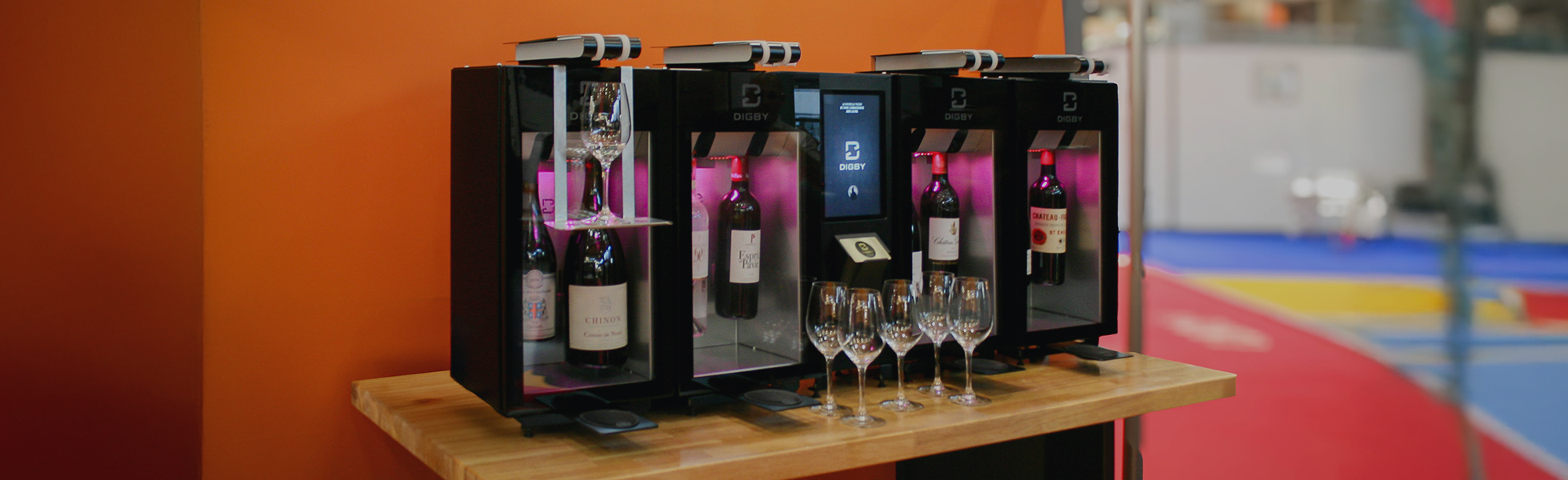
At Digby, we have developed wine-by-the-glass dispensers that fully leverage the properties of food-grade gas. Our patented technology injects either food-grade argon or nitrogen gas into the bottle during service, replacing oxygen with an inert atmosphere.
The result: your wines retain their full sensory qualities for up to four weeks after opening, just like on day one.
Designed and manufactured in France, our dispensers also feature precise temperature control. Adjustable from 6°C to 18°C, they ensure each wine is served at its ideal temperature. Bottle changes take just a few seconds, with no complex handling.
WHY WINE BY THE GLASS HAS BECOME ESSENTIAL IN RESTAURANTS
The market has changed dramatically. According to a late-2024 Viavoice study, 75% of wine consumers now drink wine by the glass, primarily in restaurants. This trend is especially strong among under-35s, who value discovery and moderation.
Fabrice Sommier, Best Sommelier of France (MOF) 2007 and President of the French Sommeliers’ Union, puts it bluntly:
“A restaurant that doesn’t offer wine by the glass sells almost nothing today.”
The economic stakes are significant. Wine can account for up to 50% of a restaurant’s profits. Yet fear of waste leads many restaurateurs to limit their by-the-glass selection or apply excessive margins.
With a high-performance preservation solution, this equation changes completely. You can offer quality wines by the glass, with fair pricing, without risking loss.
THE BENEFITS OF DIGBY WINE DISPENSERS FOR YOUR BUSINESS
Our wine-by-the-glass dispensers transform your offering:
- Expand your wine list: offer premium wines by the glass without fear of unfinished bottles
- Eliminate waste: with up to 4 weeks of preservation, no bottle is thrown away
- Guarantee quality: every glass served matches the first, even weeks after opening
- Optimize margins: fewer losses allow competitive pricing without sacrificing profitability
- Enhance the customer experience: guided or self-service wine discovery adds value
Our range adapts to every type of establishment.
The Duo wine dispenser holds two bottles, which is ideal for assisted service at the counter or in the dining room.
The Digital wine dispenser, available in 4, 6, 8 bottles or more, enables self-service via an intuitive touchscreen interface which is perfect for wine bars and tasting areas.
OXIDIZED WINE VS. OXIDATIVE WINES: HOW TO DIFFERENTIATE THEM
It is important not to confuse oxidized wine (a fault) with oxidative wine (a winemaking style).
Some wines are intentionally aged in contact with air to develop specific aromas. This is the case with Vin Jaune from the Jura, made from Savagnin grapes and aged for six years under a veil of yeast. Sherry, Tawny Port, Madeira, as well as Banyuls and Rivesaltes from southern France also belong to this family.
These wines naturally express notes of walnut, curry, or dried fruit and are highly appreciated by enthusiasts.
For all other wines, however, oxidation remains an enemy to be controlled.
FAQ
Can a slightly oxidized wine be served to a customer?
It is not recommended. A knowledgeable guest will immediately detect the flaw, ruining the experience. Slightly oxidized wine can, however, be used in cooking, particularly for sauces.
Do argon or nitrogen alter the taste of wine?
No. Argon and nitrogen are noble gases, completely inert. They have no smell, no taste, and do not interact chemically with wine, which is precisely why professionals rely on them.
Are Digby dispensers suitable for sparkling wines?
Our dispensers are designed for still wines (red, white, and rosé). Sparkling wines require a specific technology to maintain pressure and carbonation.
CONTROL OXIDATION AND GROW YOUR OFFER FOR WINE-BY-THE-GLASS
Oxidation is no longer inevitable. With Digby wine dispensers, you benefit from reliable French technology that protects your wines for up to four weeks after opening.
Offer an ambitious wine-by-the-glass selection. Serve premium wines without fear of waste. Deliver a flawless tasting experience to your guests.
Check out our solutions and schedule a live demonstration with our team through the contact form below.
To check out the other blog posts by Digby, click here.